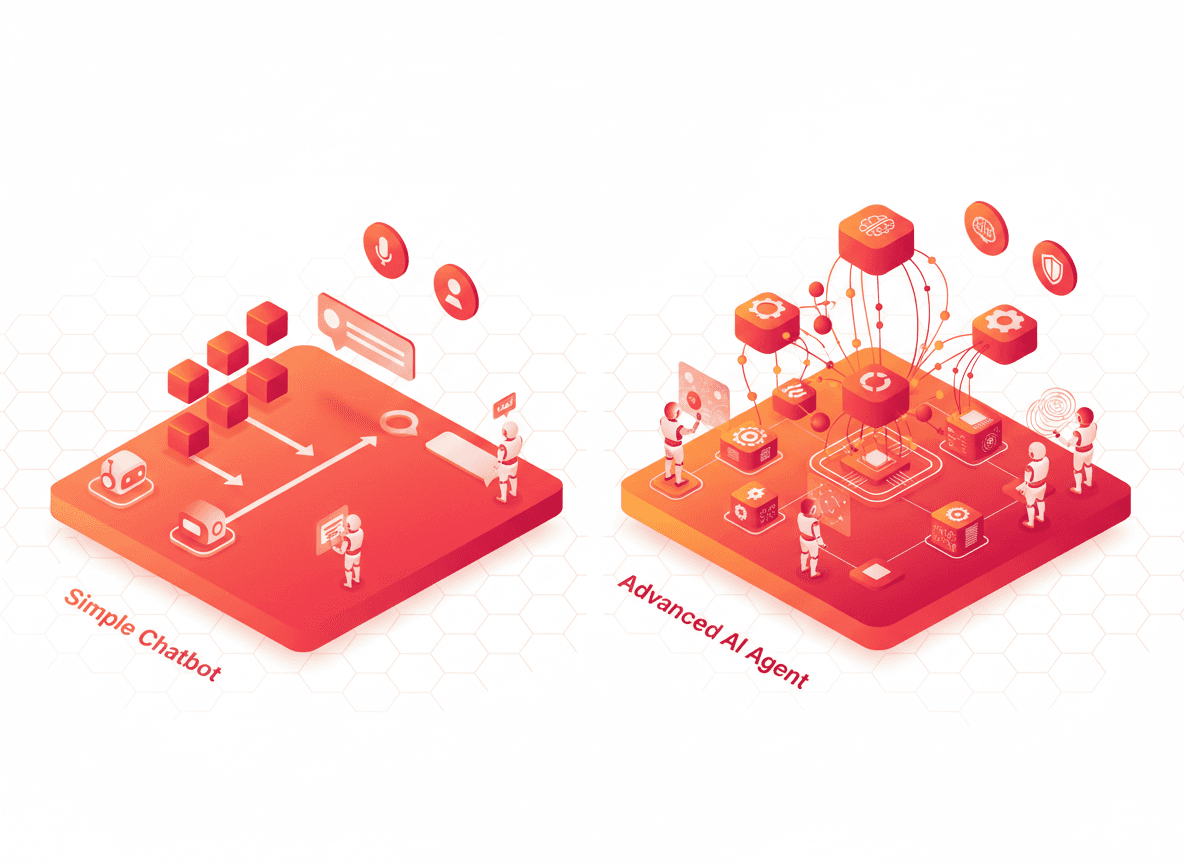
"Should I get a chatbot or an AI agent?" It's the question every business leader asks in 2026.
The confusion is understandable. Marketing blurs the lines. Vendors use terms interchangeably. But the difference matters—a lot. Choose wrong, and you'll either overpay for capabilities you don't need or underpay for a solution that can't deliver.
At BuiltABot, we've built a platform that bridges this gap—AI agent capabilities at chatbot-friendly pricing starting at $29.99/month. This guide gives you the clarity to make the right choice.
Quick Comparison: AI Agent vs Chatbot
| Capability | Chatbot | AI Agent |
|---|---|---|
| Decision Making | Script-based | Autonomous reasoning |
| Task Complexity | Single-step Q&A | Multi-step workflows |
| System Integration | Limited | APIs, databases, tools |
| Resolution Rate | 30-40% | 70-85% |
| Learning | Static | Continuous improvement |
| Typical Cost | $0-50/month | $29.99-500/month |
| ROI Multiplier | 1x baseline | 3x average |
What Is a Chatbot?
A chatbot is a software application that simulates human conversation through text or voice interactions. Traditional chatbots operate on pre-defined rules and scripts.
How Chatbots Work
Chatbots follow a simple pattern:
- Pattern Recognition: Identify keywords in user input
- Script Lookup: Find the matching pre-written response
- Response Delivery: Display the scripted answer
If a user asks something outside the scripted scenarios, the chatbot fails or escalates to a human.
Chatbot Strengths
- Low cost to implement
- Quick deployment for simple use cases
- Predictable, controlled responses
- Good for FAQ-style interactions
Chatbot Limitations
- Cannot handle unexpected questions
- No learning or adaptation
- Requires manual scripting for every scenario
- High escalation rates (60-70% of inquiries)
- Cannot take actions in external systems
What Is an AI Agent?
An AI agent is an autonomous software system that perceives its environment, reasons about goals, and takes actions to achieve objectives—without step-by-step human instruction.
How AI Agents Work
AI agents operate through a continuous loop:
- Perceive: Understand user intent and context
- Reason: Plan the steps needed to achieve the goal
- Act: Execute actions (respond, query database, call API)
- Evaluate: Assess if the goal was achieved
- Iterate: Adjust approach if needed
Key Difference
Chatbots respond. AI agents reason and act. This is not a matter of degree—it's a fundamental architectural difference.
AI Agent Strengths
- Handle complex, multi-step tasks
- Integrate with external systems (CRM, calendar, helpdesk)
- Learn and improve from interactions
- Resolve 70-85% of inquiries without escalation
- Adapt to unexpected scenarios
AI Agent Considerations
- Higher upfront cost (though BuiltABot starts at $29.99)
- Requires guardrails for autonomous actions
- Monitoring needed for quality assurance
7 Key Differences Between AI Agents and Chatbots
1. Autonomy Level
Chatbots: Zero autonomy. Every response is pre-written.
AI Agents: High autonomy. Can decide what actions to take based on goals.
2. Task Handling
Chatbots: Single-turn Q&A. "What are your hours?" → "We're open 9-5."
AI Agents: Multi-turn workflows. Handle a complete refund request from verification to processing.
3. System Integration
Chatbots: Display information only.
AI Agents: Read from and write to databases, CRMs, calendars, payment systems.
4. Response Generation
Chatbots: Template-based. Select from pre-written responses.
AI Agents: Generated contextually. Create unique responses based on situation.
5. Learning Capability
Chatbots: Static. Same responses forever unless manually updated.
AI Agents: Improve over time based on interactions and feedback.
6. Error Handling
Chatbots: "I don't understand" → Escalate to human.
AI Agents: Reason about alternative approaches, ask clarifying questions.
7. Scalability
Chatbots: More scenarios = more scripts = more maintenance.
AI Agents: Learn new scenarios from existing knowledge without new programming.
Performance Comparison: Real Data
Resolution Rates
- • Traditional Chatbots: 30-40% of inquiries resolved without escalation
- • AI Agents (BuiltABot): 70-85% of inquiries resolved without escalation
- • Improvement: 2x+ more issues handled automatically
Customer Satisfaction
- • Traditional Chatbots: 65% satisfaction score
- • AI Agents: 85%+ satisfaction score
- • Why: AI agents understand context and solve problems, not just answer questions
Cost Analysis: Total Cost of Ownership
| Cost Factor | Basic Chatbot | Enterprise AI Agent | BuiltABot |
|---|---|---|---|
| Monthly Subscription | $0-50 | $500-2,000 | $29.99-149.99 |
| Setup/Implementation | $500-2,000 | $10,000-50,000 | $0 (self-serve) |
| Script Maintenance | $200-500/month | Included | Included (AI learns) |
| Escalation Cost* | $2,000-4,000 | $500-1,000 | $300-700 |
| Year 1 Total | $5,000-10,000 | $20,000-75,000 | $660-2,100 |
*Escalation cost = human agent time handling unresolved inquiries (assumes 1,000 monthly inquiries)
The math is clear: BuiltABot delivers AI agent capabilities at a fraction of enterprise pricing, with ROI that typically pays for itself within 30 days.
When to Use Each Solution
Choose a Basic Chatbot If:
- You have fewer than 100 inquiries per month
- All questions are predictable FAQ-style
- You don't need system integrations
- Budget is extremely limited ($0-50/month)
- You have staff to maintain scripts regularly
Choose an AI Agent (BuiltABot) If:
- You have 100+ inquiries per month
- Questions vary or require context
- You need appointment scheduling or lead capture
- You want to reduce support costs significantly
- You need 24/7 coverage without hiring
- Customer satisfaction is a priority
Making Your Decision: Which Solution Is Right?
The choice between AI agents and chatbots isn't about which technology is "better"—it's about which aligns with your business needs and goals.
The data strongly favors AI agents for most business applications: 70-85% resolution rates vs 30-40%, 3x better ROI, and significantly higher customer satisfaction. The only scenario where basic chatbots still make sense is extremely simple, low-volume use cases where you're willing to accept high escalation rates.
What's changed is accessibility. You no longer need enterprise budgets for AI agent capabilities. BuiltABot starts at $29.99/month—the price of a basic chatbot—but delivers true AI agent functionality: autonomous reasoning, system integration, appointment scheduling, and continuous learning.
The Bottom Line
If you're evaluating chatbot solutions in 2026, skip the basic chatbots entirely. AI agents at accessible price points (like BuiltABot) deliver dramatically better results without the enterprise price tag.
Start your free 14-day trial and see the difference an AI agent makes for your business.